Monday, May 5, 2014

Hochficht Ski Trip

In February, I had the pleasure of accompanying some first year students from Gymnázium Strakonice on their week long ski course at Hochficht Ski Resort in Austria. The majority of students owned skis or snowboards, however, some did rent them in advance. One of the Physical Education teachers let me borrow his wife's equipment so I could save money, which was extremely kind!

Hochficht is a relatively easy mountain compared to the Alps, but much closer and cheaper for Czechs, especially since Czech schools traditionally book accommodation in Černá v Pošumavi, a Czech town near the border of Austria. The accommodation was located right on a beautiful lake with the Šumava mountains in the background, which made for picturesque sunsets!


Each day we would ride the bus for about an hour to get to Hochficht and an hour back, which honestly wasn't bad at all. We occupied our time by watching films. When it comes to censorship and age-appropriate films in an educational setting, there seem to be no rules in this country. We watched The Hangover, The Hangover II, The Hangover III, and The Stranger, all American films dubbed in Czech. I've seen some dubbed films before, but it's always strange, especially when you know the movie plots. I've recently learned that all the famous American actors have specific Czech individuals assigned to them when dubbing movies. This makes for a more realistic experience and Czechs can identify more with the character and his/her assigned voice.

In contrast, American students may only watch G, PG, and PG-13 films. They cannot contain too much violence nor sexual scenes. Inappropriate language is forbidden (or as a teacher I must skip over the parts when I know a curse is about to be said). It's all very ironic as I hear my students from the States say inappropriate language on a daily basis (though I try to discourage them) and I know they watch these types of films all the time at home. These rules have become much stricter since I was a student, which of course, wasn't all that long ago! Teachers must be careful and follow the rules. My first year of teaching I received a warning because my Assistant Principal walked in while I was showing Recount to my U.S. Government class, which only had Seniors, and two curses (out of a total of five during the entire film) were said. Needless to say, I've been extremely careful ever since!

Anyway, back to the ski trip. Here's a trail map so you can see the type of mountain we skied. In the States the trails are marked green (easy), blue (medium), black (hard), but in Europe it goes blue (easy), red (medium), black (hard).


The class was split into three different groups. Based on my skiing abilities, I decided to go with the middle group. They were a perfect match! Most of us had skied previously, but none of us went all that often. In my case, I've been skiing since I was thirteen years old, but I usually only ski 3-7 days out of the whole year. 

The ski trip consisted of us skiing a morning session from 9:30-12:00, breaking for lunch and relaxation (which is mandatory for the students) from 12:00-1:30, then skiing an afternoon session from 1:30-4:00. The teachers would meet back at the bus from 1:00-1:30 each day for a "coffee break", where we just talked, drank something hot, and ate some biscuits. 
Teachers

Let's be honest. I can't remember the last time I skied for more than three days. I took a short nap at lunch. I also only made it during the morning sessions for the fourth and fifth days, which was totally fine with me. This was a lot of skiing! While I was busy napping, Tomaš (one of the P.E. teachers) was busy taking pictures of his food or having someone take pictures of him tanning in the sunshine. He then sent them to his friends who were at work. It was all very comical!


My group mainly stayed on the easy and medium trails. Although it was February, as previously stated, we've had a relatively warm winter here in Europe. It was nearly 45F/7C and sunny each day. Honestly, I hate being freezing so the warmer weather was nice, but it made for terrible ski trails.

Ski Lift

Riding the Ski Lift

Each day it seemed to get warmer, and more and more snow started melting. The trails became smaller and smaller. Apparently, the snow machines can only be turned on and create new snow if it's below 32F/0C, which wasn't happening, even at nighttime! This was one of the worst trails we encountered:


In terms of technological advancement, Austria blows the States out of the water. They use key card ski passes, which you can just put in your jacket pocket, and they use turnstiles before each lift. Obviously, if you do not have a key card ski pass, you cannot pass through the turnstile. The key card ski pass has a small deposit fee. When you return it at the end of the day, or week, you get the deposit money back. 


Instead of using chairlifts, the easiest trails have these pole things that kind of look like anchors. Two people at a time can use them. You grab onto the pole then put part of the anchor underneath your butt. It then hoists you up the mountain, but very slowly. I didn't particularly care for these contraptions. You can put some weight onto it, but it's more like you're standing and skiing up the mountain.


Of course, when going to the medium or hard trails, chairlifts were essential. The mountains were not extremely high, so no gondolas were needed.

On a Chairlift

Skiing

There was still a nice view despite the lack of snow.


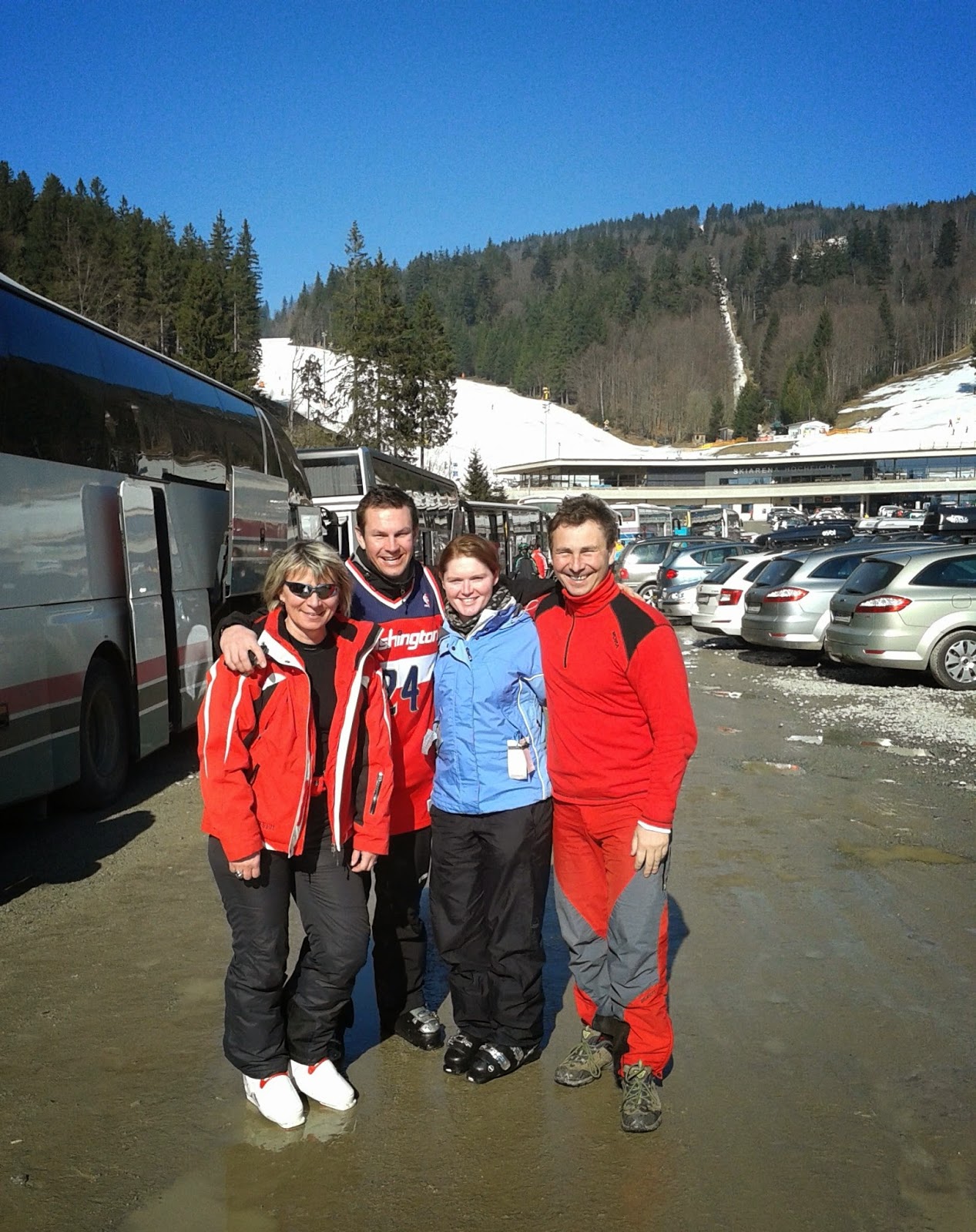
Here I am, in the light blue Smurf-looking jacket at the bottom right, with everyone.


Ultimately, I had a great time on the ski trip in spite of insufficient snow. It allowed me to practice my Czech since two of the P.E. teachers do not speak English. More importantly, I was able to get to know this particular group of students on a more personal and individual basis. To date, these students are the ones whose names I remember the most at school. The students were friendly and included me in their discussions at lunch, on the bus, while riding the ski lifts, and during free time at night, when I played ping pong with them. They were courageous in speaking English with me and I was patient as they found their words and formulated ideas. It's not an easy task to talk freely and openly without a textbook dictating the conversations or activities, so for that, I give them a lot of credit!

Thursday, April 24, 2014

Veselé Velikonoce

One of my favorite aspects of living in the Czech Republic for an entire year is the fact that I get to experience all of their unique holiday traditions firsthand. This includes Velikonoce, or Easter, which we celebrated this past weekend.

A few weeks prior to the holiday, Easter markets spring up in various major towns, where individuals can indulge in traditional Czech festival foods and sweets. Stalls have your typical souvenirs for tourists as well as neat crafts. I visited the markets in Prague various times, because who doesn't love sausage baguettes, freshly made potato chips, or fruits dipped in chocolate?! There was also a stage set up so individuals and groups could perform short skits, sing carols, or play instruments. The atmosphere really puts one in the holiday spirit!

My friend invited us to attend an Easter festival with her Czech colleagues at Hrad Křivoklát on Saturday, which is roughly two hours from Prague by train. Unbeknownst to us, we were going to ride on an actual steam train from the 19th century to the castle, which only runs three times a year in the Czech Republic; twice during Easter weekend and once in autumn.

Steam Train

As you can see below, mainly small children were taking photographs in front of the steam train, but that did not stop us from getting in on the action!

Me & Twee

Michael

Wheels

Of course, steam engines require coal as a source of power. The train had to make two stops during the journey so the operators could add more coal to the furnace. Instead of adding coal slowly throughout the duration of the journey, it was added only twice in big heaps.

Coal Store Room

We reserved seats ahead of time and were placed in the eighth carriage. Here we are walking outside from the front of the train towards the back.

Twee

Originally, they used carriages that had uncomfortable wooden seats so families could "enjoy" a real steam train experience from the past, however, over time they upgraded to carriages from the 1940s, which although the seats were pretty comfortable, there was no heat inside and I was freezing! Also, the toilet just had a hole in the bottom so all of your waste wound up on the tracks. My tush definitely got cold in that minute or two from the wind that went up the hole as the train moved forward!


We then arrived at our destination and made the pilgrimage to the castle with everyone else. 

Leaving the Train Station

Crossing Over a Bridge & River

Climbing a Hill

We finally arrived at Hrad Křivoklát!

Me & Michael

The Easter festival had a stage with people performing fairytale stories with puppets for children, singers, and bands playing throughout the day. We were able to take a step back in time to the 15th century, where craftspeople-- woodcarvers, blacksmiths, and basket weavers, were working and selling their products. There were food stalls and other crafts being sold as well.

Easter Balloons

Food Vendors

Various Types of Cheese

The Czechs have very special Easter eggs called kraslice, which is one of two symbols that represent Easter here. They take decorating eggs to a whole new level. The actual egg is removed by poking small holes in the top and bottom of the shell and blowing the insides out. Then, the shells are boiled. Czechs have various ways of decorating them including using bee's wax, straw, watercolors, onion peels, and picture stickers. Many are hand painted and some even have hole punched designs. How they get tiny hearts punched all over the egg without breaking the shell is beyond me! They usually have geometric patterns, flowers, leaves, or even snowflakes as decorations. Honestly, these are the most elaborate Easter eggs I have ever seen in my life!

Easter Eggs

Blacksmith

Gingerbread Cookies

Garden Statues

There were some areas where people could try sports of old, such as using crossbows to hit targets.

Targets

Crossbows

We even took a tour of the castle, which was in Czech, so our Czech friends very nicely translated the entire tour for us! Basically, the castle was first built in the 12th century and used as a hunting residence for Czech kings. It reached its current, and greatest, development during the 14th century. Unfortunately, the castle was damaged by various fires and ultimately abandoned until the 16th century, when it was turned into a royal prison that held various distinguished guests, including a famous English alchemist named Edward Kelly. He told people he could turn metal into gold (though never apparently did it). The castle is also famous for holding the Czech king's treasures due to the heavy, thick, impenetrable interior walls. The castle's surrounding land that was used for hunting now comprises five different villages!

Easter Market


Tower View

Old Hunting Lands

Part of a Surrounding Village

Michael and I - Tower View

The following is the second symbol of Czech Easter, the pomlázka, or braided whip. This is where Easter gets interesting.

Michael

First off, Easter is mainly a pagan holiday here. This is because the religious aspects of the holiday, such as the crucifixion and resurrection of Jesus Christ, were suppressed under Communism. To the Communists, there were no gods or God. Easter was only to be celebrated as a means of welcoming spring. Some of the villages have brought back a few of the old religious traditions, but no so much in the major towns.

On the evening of Thursday, Friday, and Saturday prior to Easter, small children in the villages carry wooden rattles or noise makers and walk throughout the entire village vigorously making noise. They even stop at each house and make noise until they receive money! This symbols two things: the first is to chase away Judas, the second is to take place of the church bells, which have "flown to Rome". (During Easter weekend, the church bells do not ring). 

Easter is celebrated on Monday here. In the morning, the boys carry their homemade (or store bought) pomlázka. They go to their friends and neighbors houses, where they sing a short Easter carol to girls. Then, well, they whip girls on the butt with their pomlázka! They say that women who are whipped with a pomlázka will be healthy, young, and fertile for the coming year. In return, the girls give them eggs that they painted, chocolate bunnies, or maybe a few korunas. For older men, they usually receive a shot of Slivovice, or plum brandy, which makes for some happy and slightly drunk men by the afternoon. 

Here's a video showing various age groups and the Easter tradition of the pomlázka:


In contrast, Easter in the States is fairly commercialized. Children are brought to shopping malls where they stand in line and wait to take a picture with the Easter bunny, which is a costume worn by a person. These photographs are then sent with greeting cards to family and friends. We celebrate Easter on Sunday. When we wake up, the Easter bunny has visited our homes and left an Easter basket for each person in the household. The baskets are filled with chocolate eggs and bunnies, peeps (an American specialty sweet, which is a fluffy marshmallow covered in sugar), and sometimes small toys or presents. The day is spent with the extended family, where they eat tons of food, chat with one another, and play games. The easter egg hunt is the most famous game for children. Parents take plastic Easter eggs and fill them with small chocolates and money. Then, they hide them in the garden or backyard for children to find. This was always my favorite past time of Easter growing up. We decorate eggs, but our method is a bit easier. We simply buy an artificial egg dyeing kit from the store, boil are eggs, and dip them in cups filled with the dye, water, and vinegar, which stains them. Here's the ones Michael and I did in the Czech Republic:


Of course, there are many religious people in the States, so they do attend church services and take note of the crucifixion and resurrection of Jesus Christ as well. But alas, Easter is celebrated all over the world and a symbol that spring has arrived: longer days, more sunshine, warmer weather, the birth of baby animals, and the growth of plants and trees. It is happy time indeed!

Tuesday, April 8, 2014

Josefov

As many of you know, the Nazis decimated the Jewish population in Europe during the Holocaust of World War II. The Czech Republic was not exempt from Hitler's Final Solution, however, a small percentage of Prague's Jewish population was able to archive and store their treasures in what is today known as Josefov, or the Jewish Quarter, of the city. Though the treasures in the Ghetto survived, the archivists perished in concentration camps. Today, the variety of Synagogues and Jewish sights are all owned by the Jewish Museum in Prague.

Personally, Pinkasova Synagóga was the most intriguing building of the several I visited. The outside of the synagogue has a lovely pink facade, but the inside leaves one speechless.

Pinkas Synagogue

Every single wall in the synagogue is covered with handwritten names of the 77,297 Czech Jews who were sent from here to the gas chambers at Auschwitz and other concentration camps. I immediately felt immense sadness, which was deepened by the somber reading of names alternating with a cantor singing Psalms from speakers located in each room. Below is merely one room within the synagogue.

Inside Pinks Synagogue

The names are carefully organized by hometown (in gold, listed alphabetically). Family names are in red, followed in black by the individual's first name, birthday, and last date known to be alive. 

Up Close View

This memorial was created shortly after the end of World War II. Unfortunately, most of the information was erased when the Communists took over the Czech Republic in 1948 and the synagogues' doors were closed to the public for over twenty years. Under Communism, no religion could be practiced and nearly all religious officials fled the country before they could be persecuted. As a result, each and every name was rewritten after Communism ended.

Today, there is a Terezín Children's Art Exhibit installed on the third floor of the synagogue. If you didn't read my post on Terezín, you can do so here. For a refresher, this was the only concentration camp in the Czech Republic, where many Jewish families were sent to await their eventual departure and death at Auschwitz (which, by the way, is in Poland if you didn't know).

Terezin Children's Art Exhibit - Pinkas Synagogue

Friedl Dicker-Brandeis, a famous Czech artist and teacher, devoted the last part of her life, which was spent in Terezín, to helping the Jewish children cope with the everyday atrocities in the concentration camp. She encouraged the children to paint about things that made them happy, such as activities they participated in before the war, as well as what they believed their future would like like after the war. Of the 600 children Friedl Dicker-Brandeis taught, very few survived. However, more than 5,000 forms of artwork from the children remain with their names and ages. Before her train departed for Auschwitz, Friedl Dicker-Brandeis packed the artwork in her suitcase and hid it to be found after the war. The artwork serves as a testimony to the existence of these children and the realities of the war. Here are some examples:

Theater Performance / Musicians

Terezin Shower

Arrival at Terezin

A Happy Place

Jewish Celebration

A Butterfly

Upon leaving Pinkas Synagogue, you enter one of the most interesting cemeteries in Europe, Starý Židovský Hřbitov, or Prague's Old Jewish Cemetery. Since the Jewish population has basically been a target since the beginning of mankind, this was the only burial ground for all the Jews of Prague from 1439-1787. As a result, the tombs are layered seven or eight deep, with as many as 100,000 tombs. The tombs became piled upon one another due to the limited space and the Jewish belief that the body should not be removed once buried.


This is the tomb of Rabbi Loeb, creator of the Golem of Prague fairytale. You will notice small pebbles on top. They represent "flowers of the desert" and the small scraps of paper contain prayers.


According to the fairytale, Rabbi Loeb created a Golem from clay and gave it life through the use of fire, water, air, and earth. The Golem was to protect Prague's Jewish population from anti-semitics. 

Rabbi Loeb & Golem

After the cemetery, I viewed the Ceremonial Hall and four more synagogues; each one different and unique. They all showed various aspects of Jewish life, celebrations, and traditions throughout the centuries. The Jewish Quarter is informative and displays the realities of a persecuted life for those who practiced Judaism. Time and time again we blamed people who practiced a particular religion for wars, diseases, and natural disasters simply because they were a minority group with different customs. Unfortunately, we haven't learned much from our past. We continue to move from one minority group to another trying to blame them for our own faults: African-Americans, Latinos, immigrants, women, homosexuals. If we could all just be more accepting of each other the world would be such a lovely place to live. Individuality is a beautiful thing.