Wednesday, June 4, 2014

Maturitní Ples

Maturitní Ples. Czech Prom. How does one begin to describe it? Simply put, it's a mixture of an American prom, homecoming celebration, and debutante ball all-in-one.

Since each year is broken down into four distinct classes, for example, seniors are separated into the classes of 4.A, 4.B, 4.C., and 8.0, they each get their own Maturitní Ples. In preparation for, and advertisement of, each Maturitní Ples, each class hires someone to make an official video relating to the chosen theme for the prom.

A Maturitní Ples isn't just a celebration for the graduating students, but everyone involved in their upbringing and education. As the proverb states, "It takes a village to raise a child", and this was most evident during these celebrations. Prom tickets are sold to families, friends, schoolmates, and teachers. A ticket averages 160KC ($8) for each prom.

This year's prom themes included time traveling, hippies, the Olympic games, and black & white. Here are the class' videos:


*Please note, I had to edit and cut out some of the Olympic video as the file was too big.


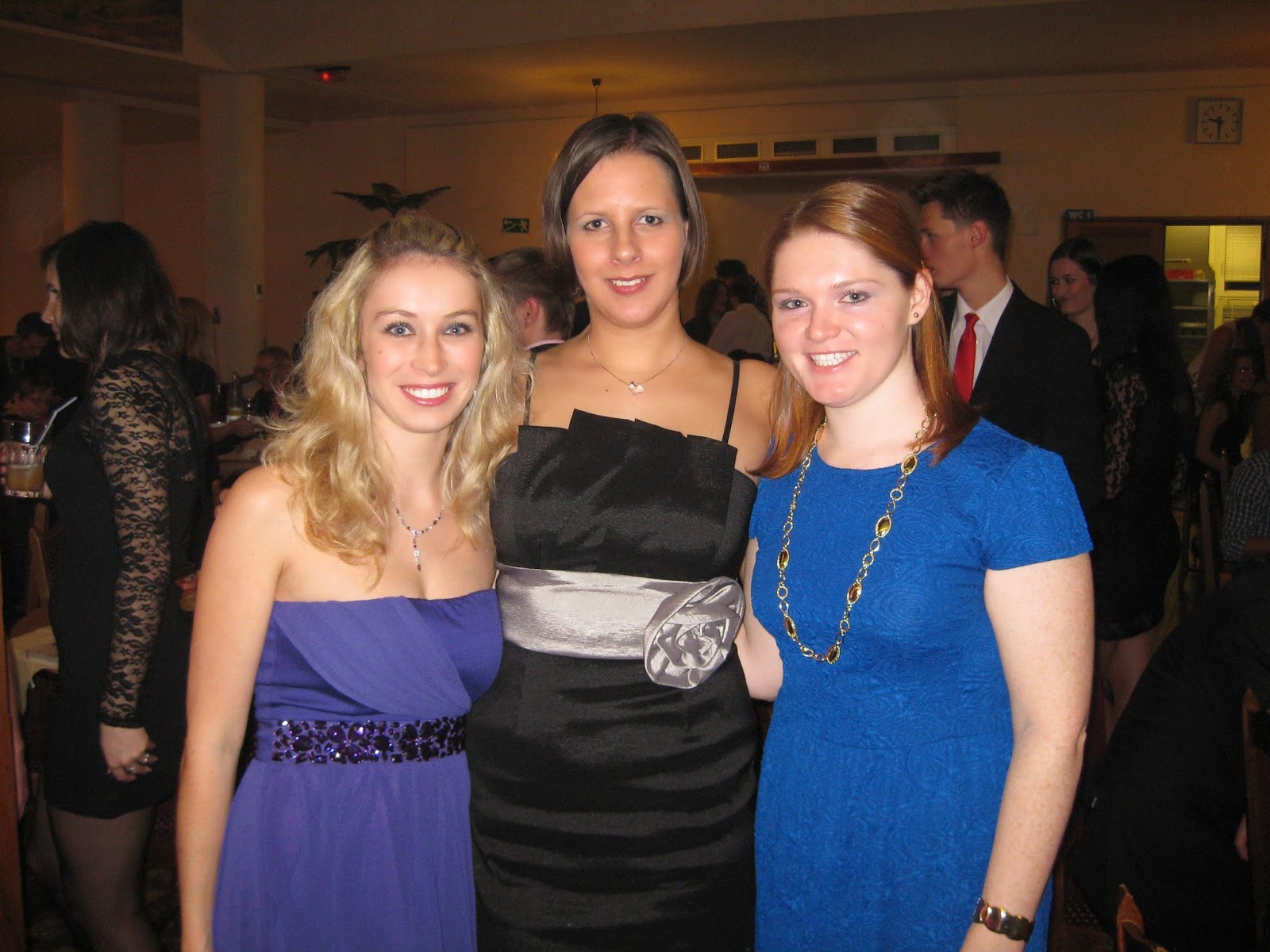
The proms, and many major events in Strakonice, are held at the Culture House in the center of town. Upon entering, there was a big lobby where a photographer awaited to take pictures of individuals and groups who were dressed to impress. Below are some photos of me with my colleagues and friends that were taken at the various proms.

Me, Romana, Jana
Mira

Me, Romana, Jana

Jana, Liba, Pavel, Milena, Me, Romana, Jana
Our student, Fanda

Monika, Jana & Me

Rudolf & Me

Me & Liba

Jana, Romana, & Me

Jana & Me

Me & Milena

Monika, Me, & Jitka

Jana, Me, Milena, Jana

The students selected the band and/or DJ for their event as well as some entertainment throughout the night. Many opening acts consisted of dance groups from around the Czech Republic, including country line dancers, hip hop dancers, and salsa dancers. Other entertainment included a magician, a bartender who did tricks, and people who performed on special jumping stilts. I only took pictures at one of the proms for the purpose of this blog (while for the others I completely enjoyed the moment). This was one of the opening acts, a hip hop dance group with a tiger in the center of their pants.


After the opening act, the honorary students made a grand entrance with dramatic music and dance formations. Unfortunately, I don't have a video of the entrance, but here's a succession of pictures from one.


Afterward there is a special ceremony, where each student is introduced with some facts and pictures from their childhood presented on a larger projector screen. There is a red carpet that each student walks down and meets the Headmaster and Head Teacher at the end of it. Here they receive a sash, rose, and glass of champagne (as the drinking age is eighteen here), and a professional picture is taken. 

Head Teacher & Headmaster


Classmates surround the red carpet and high five a student as their name is called and they walk down the aisle. Simultaneously, family and friends throw coins at the student and pop confetti as a sign of congratulations. (PS. I've seen some of the students get hit with the coins, and I feel like it's pretty painful, but this is the tradition).


The Headmaster and Head Teacher get sashes at the end with a glass of champagne as well. 


Speeches are then given by all and a congratulatory toast is had. 


By toast, what I really mean is, a quick chugging contest. There's no enjoying the champagne. The students drink it quickly, because they then use their empty glasses to collect the coins that were thrown at them during the ceremony.

Toast

Coin Collecting


Then other schoolmates (who have volunteered to help for the night) start to roll up the red carpet, sweep the floor, and clean up all the confetti.


Now, the real dancing can take place. Formal dances are held at the beginning of the night. First, there is a dance with teachers, then a dance with parents. Afterward, anyone can join. 


You see, everyone here is formally trained and must attend classes when they are fifteen years old to learn all of the traditional ballroom dances. It's like a rite of passage, and on the last day of class, there is a special night for parents and students to practice together and see how far they have come (before the Maturita Ples season, which is in winter, begins). 

Well, guess what? I'm American. I never learned any of these dances. However, I was taught country square dancing and line dancing in high school, but that wasn't of much help here. My friends taught me the waltz and polka on the spot and I felt like an idiot. I was literally the only person there who didn't know these dances, but I caught on quickly and my partners were patient :) In the end, I had tons of fun! This is honestly one of the most amazing traditions and I wish Americans would adopt it. The dances are beautiful and everyone is in sync. It's just lovely.

Afterward, the dance party begins with various forms of entertainment throughout the night. The last special aspect of the evening is the "Midnight Surprise" by the students, which in most cases is some sort of dance performance relating to their theme. This is the Hippie, 4.B class, who had a synchronized dance to songs from the 60s and 70s.


After the midnight surprise, many parents and older individuals leave the prom as it turns into a disco, or club, for the remainder of the evening. The prom eventually ends at 3AM (when it starts at 8PM), but of course, then the students continue partying into the morning at an after party somewhere. By the way, there was also a photographer and videographer for the entire prom, so families can have keepsakes and memories for years to come.

The only downside to this entire evening is that food was not included, though there are some entrees and snacks you may purchase at your leisure, especially with all the alcohol consumed by students, teachers, and parents alike. In my opinion, Czech prom by far surpasses American prom. I loved the formality of it all: the special sash ceremony, the ballroom dances, and how everyone was included in this special event, such as parents, friends, teachers, and schoolmates. Plus, the Czechs sure know how to party!

Thursday, May 29, 2014

A Czech Student's Life

The student lifestyle in the Czech Republic differs vastly from that of the States. So, let's begin...

The Czech education system is separated into three distinct levels.

1. Primary School, ages 6-15: A primary school education is compulsory for all Czechs, which means they can stop attending school at the age of 15 after passing their school leaving exams. However, they will not advance very far in society due to their low educational levels. Typically, very weak students stop here, such as the Roma population (which is a whole different topic in itself). They tend to obtain unskilled, menial, low-paying jobs in society.

Students receive their education in the same building for the entirety of their primary school education. This means six year olds are in the same building as fifteen year olds. The extreme age difference does not seem to be of any concern here. This is uniform throughout the nation. The only exception is for the best and brightest students, who have the opportunity to take entrance exams and obtain an eight-year Gymnázium education. These students will attend a Gymnázium from ages 11-19.

Students with disabilities are not mainstreamed here. They attend separate, special schools away from the regular population. At this time, I do not possess any information on how they are educated nor what services are provided to them.

2. Secondary School, ages 15-19: A secondary school education is optional and varies depending on which type of school one attends. At the age of 15, students apply to different schools and many must take entrance examinations. The best and brightest students attend a Gymnázium, which offers a well-rounded education that prepares students to take their Maturita Exam, or school leaving exam, and prepares students to excel at a university. Other options include vocational or technical schools, where students still learn ordinary school subjects, however, they are supplemented with lessons in special skills, such as hairdressing, cooking, mechanics, etc. These students may still take the Maturita Exam and go on to college, but they are less prepared compared to their Gymnázium peers. The last option is to attend a conservatory, or music school. The majority of students who attend conservatories plan to become professional musicians.

I teach at Gymnázium Strakonice, which is very modern and fully updated compared to some of its equivalents in other cities. The school day begins at 7:00, but only for those who are taking a fourth language, such as Spanish, French, Italian, or Latin. The majority of students begin their day at 7:50 with second period. The lessons last for 45 minutes, but the breaks between lessons are quite long. In the morning there are often ten minute breaks between lessons, with one twenty minute break after the third lesson. After the lunch periods, the breaks decrease to a mere five minutes between lessons. Students hang out in their classrooms or outside between periods, chat, play games, eat snacks, or go to the bathroom. They are completely unsupervised. Of course, if there is some sort of commotion, the teachers leave their offices to see what's going on, but this is a rare occasion.

At both the primary and secondary levels, students take up to fourteen subjects at one time. These include: Czech, English, German, History, Geography, Ethics, Philosophy, Mathematics, Biology, Chemistry, Physics, Civil Sciences, Information Technology, Art or Music, and Physical Education. They do not take each subject every day. Students typically take language classes three or four times per week and mathematics four times per week, otherwise all other subjects are only taken twice a week. They have a total of thirty-three lessons per week. Thus, the students will end their school day at different times each day. The earliest students may finish is 12:20 and the latest is 3:45.

Each grade level is separated into four cohorts. For example, 1.A, 1.B, 1.C, 5.0 (The 5.0 being for the eight-year Gymnázium students). This would be the Freshmen class. The students stay with their individual cohort throughout their entire secondary education. There is no mixing and mingling of students or grade levels. Tracking is used in this nation, so the students are split up according to their skills and abilities Therefore, 1.A. might be the strongest, highest achieving students, 1.B medium-level, and 1.C lowest level. There are usually up to thirty-two students per class, except for language classes, where the cohorts are split into two groups (again weaker versus stronger) for a maximum of sixteen students per class.

A Gymnázium education is very demanding. Students mainly hear lectures and are expected to learn the information and retain it. There seems to be little time for analyzing and synthesizing information or applying the material to real world situations. There's no creativity or student projects. Czech students do not know how to properly complete research or write papers before they enter a university, which is one of the education system's downfalls. There is no such thing as homework in this nation either. The students rarely, if ever, get any. They are expected to study on their own everyday after school.

There are only two standardized tests: one for leaving primary school and one for leaving secondary school. The Maturita Exam consists of four subjects. Students must take Czech language and one second language, usually English or German. The other two subjects are up to their discretion. Each examination is different. Languages consist of reading, writing, speaking, and listening parts. Mathematics is strictly written. The sciences have laboratory parts in addition to written parts. The social sciences consist of fifteen minute oral examinations. There are a total of 25-33 topics for each subject, where of course, a student may only be tested on a few.

As for fun, there are no extracurricular activities, such as clubs or sports, held at the school. These types of activities are run by the towns and students must pay to participate on their own time. Some of my students are enrolled in activities like CPR and first aid, ballet, basketball, ice hockey, water polo, tennis, and/or soccer. The only thing my school does have is a Choir. I went to see their spring concert last month and it was magnificent. In addition to singing, the students themselves played the piano, guitar, violins, and drums when needed. They are quite talented. Here are some video clips:


3. University, ages 19-26: University education is free for all Czech citizens. Most schools require entrance examinations, and some universities, such as the ones in Prague, are highly competitive. When applying to universities, you apply to specific schools, such as The School of Economics, The School of Education, The School of Medicine. You begin your studies immediately in your chosen field. There's no period allowed for being "undecided". If you decide to change majors, you must apply to a new school and begin again as credits usually do not transfer. As you may have noticed, students attend secondary school for an extra year here, however, they obtain their equivalent of a Bachelor's degree in just three years. In this country, a Bachelor's doesn't really mean anything. It is expected that you continue your studies, for a total of five or six years, to obtain a Master's degree. Czechs do not work while attending school, unless it is something simple and part-time. They are expected to concentrate on their studies, and obtain a full-time job after the age of 26.

That's the Czech education system in a nutshell.